Articles & Research • Casting A Digital Twin
Casting A Digital Twin
11th November 2026
The concept of the digital twin is well known to engineers to most manufacturing processes with the exception, because of the sheer quantity of different variables, of casting. In 2021 Sarginsons, a long established aluminium foundry, successfully mapped a number of characteristics from a solidification analysis onto a Finite Element Analysis (FEA) mesh, to enable complex stress and structural models of whole vehicles to be tested. Effectively crash testing virtual cars and their castings to created localized simulations of mechanical TYE performance for the first time.
A grant funded collaboration, LEVA, between Lotus Cars and Sarginsons, a specialist in lightweight cast automotive structures, then fully tested the accuracy of Sarginsons new digital twin for cast components.
Firstly, a typical lightweight cast car structure component was simulated through the casting & heat treatment processes; the resulting mechanical properties were then mapped to an LS-Dyna FEA Mesh and the virtual bend test carried out on a test beam. Most importantly homogenous TYE data was not applied across the whole form, as can be seen, instead localized TYE performance was mapped, as mechanical performance across a component is never homogenous. For the first time the actual mechanical stress could be simulated and tested at ‘any point’ across the form.
Having established the virtual test results actual beams were cast, heat treated and put through a physical bend test for direct comparison of the ‘Real Twin’ to the ‘Digital Twin’. The mapped elongation and proof test results are shown (figure 1).
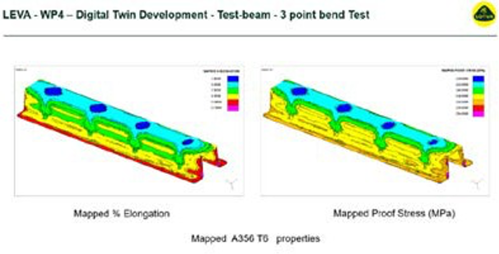
Figure1: Mapped Elongation and Proof Stress Result.
An initial set of three quasi-static 3-point bend tests were completed with the set up shown as below
Figure 2
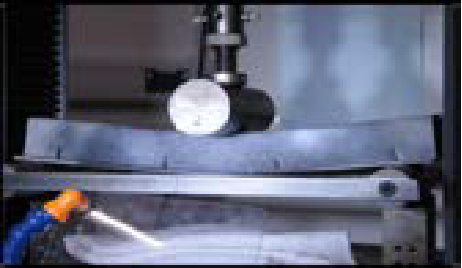
The strain measurements at initial failure in CAE are show in the figure below (Fig. 3). Peak tensile “side wall” strains of approx. 3% and compressive strains of -3.5% were seen in the CAE prediction.
While no one was injured, nor a car crashed, it does show the accuracy and potential of this new simulation technique and just how far developments in complex analysis software packages such as LS-Dyna have come.
Since the LEVA study of 2021 Sarginsons has continued to develop its simulation techniques and has considerably increased the data sets used to power the simulations. It has completed several actual projects where the simulations were able to assist in mass reductions of between 20% and 37% over previous designs.
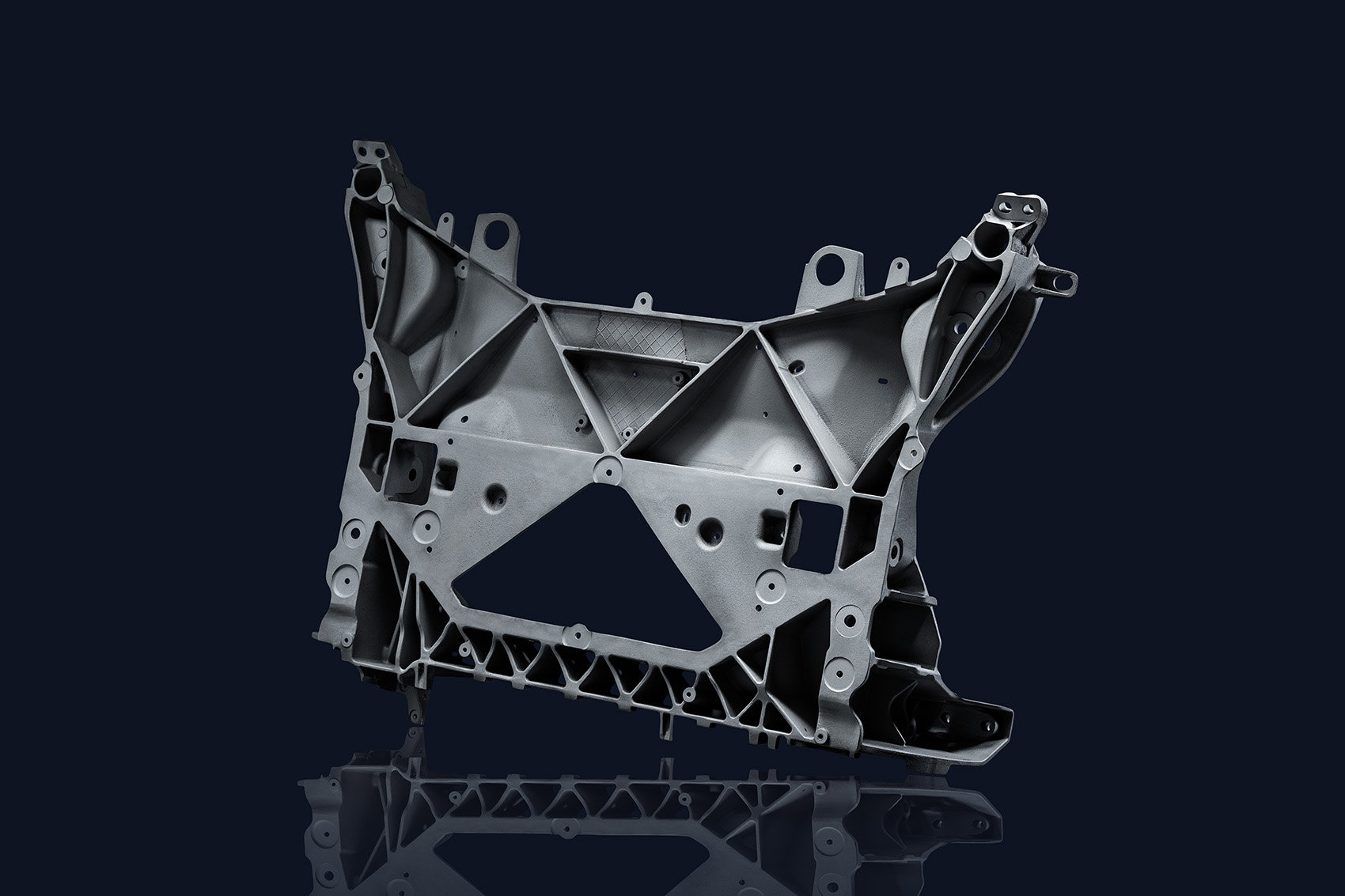
The ability to free designers from the ‘play safe’ approach dictated by the lack of knowledge of mechanical performance has opened the door to an increased ability to combine components into single piece castings, reducing weight and manufacturing costs. This can be seen in figure 4 where nine sub-frame components were combined into one, with the resulting physical crash test proving Sarginsons simulations to within 2%.
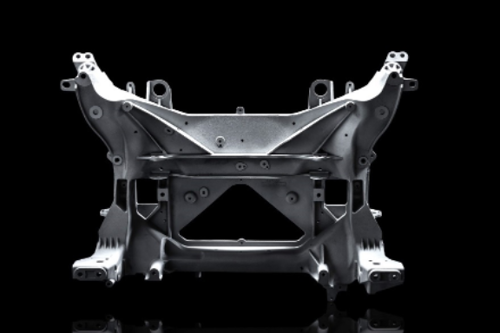
Figure 4
The secret to lightweighting is not the digital twin simulations but the ability to apply unfettered topological optimisation, the mathematics of lightweighting, to any design study. The results are phenomenal in both presenting radical new design ‘organic’ structures but also in the mass reduction being achieved.
Sarginsons is also finding it can predict heat treatment distortion with a view to ‘designed deformation’ as a means of negating its complexity or, more recently, the ability to use targeted cooling, smart tooling and corrective orientation as a means of negating these distortions.
The same simulations have also been adapted to produce Youngs Modulus predictions and to predict fatigue performance in areas such as aerospace and bike design.
Sarginsons leads the world in its ability to simulate the mechanical performance of castings. An ability that will be rapidly enhanced by its successful leadership of a £6m grant application, in July 2024, to develop a faster, more integrated approach to solidification, simulation and topological optimisation.
Any OEM developing an aluminium casting today without running a Sarginsons simulation first is essentially throwing away product performance, money and carbon.
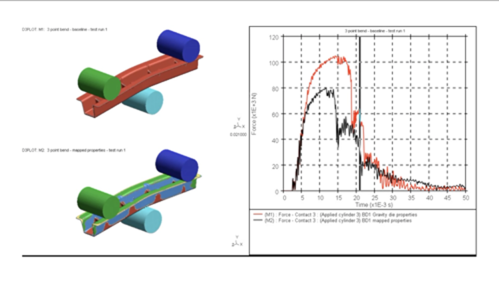
Figure 5
Torrington Avenue, Coventry,
West Midlands, CV4 9AG