
Articles & Research • Guide for Companies: Overcoming Structural Weaknesses in Recycled Aluminium
Guide for Companies: Overcoming Structural Weaknesses in Recycled Aluminium
11th November 2026
Recycled aluminium offers significant environmental and economic benefits, requiring only about 5% of the energy needed for primary production from bauxite. However, structural weaknesses often arise due to contaminants such as iron (Fe), silicon (Si), copper (Cu), and other impurities that accumulate during recycling, leading to reduced strength, ductility, and fatigue resistance.
These issues stem from heterogeneous scrap sources, oxidation, and incomplete separation processes. This guide outlines steps a company can take to address these challenges, drawing on Sarginsons Industries' pioneering work in the UK, as well as global research and innovations. It includes practical considerations, potential difficulties, and strategies for implementation.
Step 1: Assess and Understand the Challenges
Before implementing solutions, conduct a thorough audit of your recycling stream to identify specific weaknesses.
Key Challenges in Developing High-Strength Recycled Alloys
Recycling aluminium introduces impurities that degrade mechanical properties. For instance, Fe levels above 0.10-0.15% can form brittle intermetallic phases, reducing toughness in aerospace or automotive applications. Global studies highlight the following issues:
• Contaminant Buildup: Impurities like Fe, Si, and Cu increase with each recycling cycle, as they are difficult to remove completely. MIT research shows that without intervention, contaminants could accumulate to levels that render 6.1 megatons of scrap unrecyclable by 2030.
• Sorting and Separation Difficulties: Mixed scrap (e.g., Zorba) contains non-ferrous contaminants, plastics, and other metals, complicating purification. In wrought alloys, tight composition controls are needed, but scrap variability leads to inconsistent properties.
• Microstructural Degradation: Oxidation during melting causes material loss (up to 46%), forming defects like pores or inclusions that weaken the alloy.
• Economic and Scalability Hurdles: High-purity recycling is energy-intensive and costly, with challenges in maintaining quality for high-performance uses like automotive chassis.
• Alloy-Specific Problems: Wrought alloys (e.g., for sheets) tolerate less Fe than cast alloys, limiting direct recycling without dilution by primary aluminium.
Sarginsons' experience in the PIVOT project illustrates these: recycled aluminium inherently contains impurities that weaken grain structures, requiring innovative refinement to achieve primary-like strength.
Challenge | Description | Strength | Examples |
Impurity Accumulation | Fe, Si buildup forms brittle phases
| Reduces Ductility by 20- 50% | MIT study predicts unrecyclable scrap Surge by 2030 |
Oxidation and Loss | Material loss during melting | Yield as low as 54% | EU RecyclAI project on FE removal |
Scrap Variability | Mixed Alloys after composition | Inconsistent properties | Aerospace alloys restrict Fe <0.15% |
Economic Barriers | High Sorting Costs | Limits Scalability | US transformation Industry faces pressure |
Step 2: Implement Advanced Sorting and Pre-Treatment
Improve input quality to minimise contaminants from the start.
• Advanced Separation Technologies: Use eddy current separators, X-ray transmission (XRT) sorting, or infrared systems to remove non-aluminium materials. TOMRA's X-TRACT unit achieves 99% purity by separating magnesium and plastics from Zorba scrap.
• Pre-Treatment Methods: Manual sorting, shredding, and cleaning reduce large contaminants. MIT extensions of ore separation techniques can adapt for recycling.
• Closed-Loop Systems: Source scrap from known origins (e.g., end-of-life vehicles) to control inputs. Sarginsons collaborates with Gescrap for sorted, high-quality scrap in PIVOT.
Difficulties: High initial costs for equipment; incomplete separation for trace elements. Solution: Partner with recyclers like Gescrap for expertise.
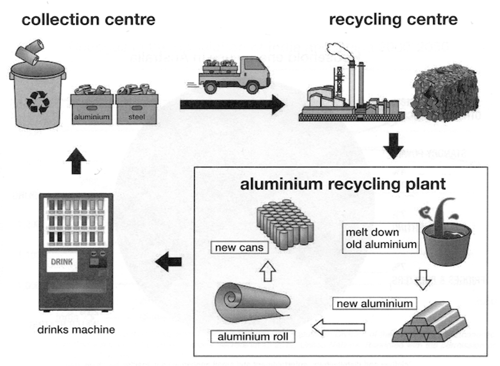
Diagram of aluminium recycling stages
Step 3: Apply Purification and Alloying Techniques
Refine the melt to remove or neutralise contaminants.
• Impurity Removal Methods: Add elements like manganese (Mn) or beryllium (Be) to form high-melting compounds that sediment out Fe. Direct smelting or multi-component alloys (e.g., Mn-Cr-Ni-Zr) are used industrially.
• Grain Refinement: Sarginsons, with Brunel University and Gescrap, uses rare earth elements and innovative techniques to refine grain structures, overcoming impurity weakening. This enables 100% recycled alloys for structural parts, reducing CO₂ by 95% while matching primary strength.
• Advanced Processing: High shear processing (HSP) or hot forging enhances strength and plasticity. EU's RecycAl project reduced Fe in casting alloys via HSP + sedimentation.
• Solid-Phase Alloying: Upcycling via extrusion avoids melting losses, balancing strength with scrap use.
Difficulties: Thermodynamic limits on Fe removal; potential environmental concerns some additives. Sarginsons faced years of R&D to industrialise refinement. Solution: Use simulations for optimisation.
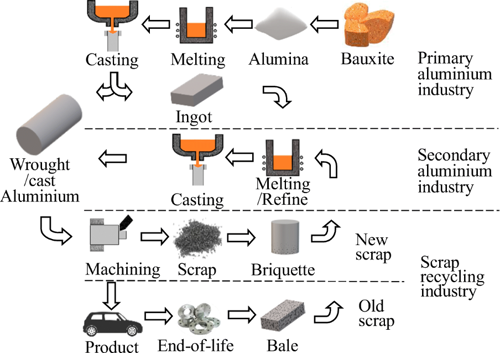
Illustration of primary vs. secondary aluminium production and recycling:
Step 4: Optimise Microstructure and Heat Treatment
Post-processing restores properties.
• Controlled Solidification: Adjust cooling rates and heat treatments to refine microstructure, reducing defects.
• Strengthening Mechanisms: Leverage grain boundary, solid solution, and precipitate strengthening. Upcycled alloys show higher strength than traditional recycled ones due to refined microstructures.
• Alloy Design Strategies: Develop "dirty alloys" tolerant to impurities, as explored by team at Max-Planck-Institut.
Difficulties: Oxygen ingress during processing; balancing cost with performance. Solution: Inert atmospheres and AI-driven controls.
Step 5: Validate, Scale, and Collaborate
• Testing: Use fatigue and tensile tests to verify strength. Sarginsons targets structural applications like subframes.
• Scaling: Start with pilots, seek grants (e.g., UK's APC funding for PIVOT).
• Partnerships: Collaborate with universities (e.g., Brunel) and recyclers (e.g., Gescrap) for R&D.
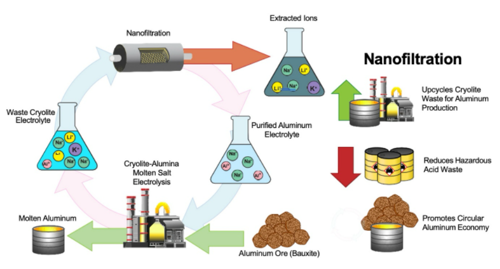
This nanofiltration diagram shows an innovative approach to upcycling waste for circular economy benefits
By following these steps, companies like Sarginsons demonstrate that recycled aluminium can achieve primary-equivalent strength, promoting sustainability. Ongoing global research emphasises the need for continued innovation to address persistent challenges.
Torrington Avenue, Coventry,
West Midlands, CV4 9AG